
Mattresses for sensitive backs: finding the perfect lumbar support
Our reviews are independently written. To help fund our testing, this site contains affiliate links. This allows us to remain free while ensuring that our recommendations remain unbiased. See how we work.
Introduction: Why has waking up become such a struggle?
The alarm goes off. But instead of jumping out of bed with the energy you need to tackle your day, you drag yourself out of bed with difficulty. With one hand pressed against your lower back and a grimace on your face, you wait for that “morning stiffness” to subside. For many people, this is a normal routine. Yet science is clear: this pain is often a warning sign of a spine that has been poorly supported for 8 hours.
Back pain affects 80% of the population at some point in their lives. It’s the ailment of the century. Yet we spend a third of our lives on an object we all too often neglect: the mattress. For a sensitive back, a mattress isn't just a comfort accessory; it's a genuine health aid, just like a pair of orthopedic shoes for a marathon runner.
The quest for lumbar support mattress for back pain is fraught with pitfalls. Between vague marketing terms like “space-age technology,” “ergonomic foam,” and “hotel-quality firmness,” consumers are left confused. In this comprehensive guide, we’ll break down the precise mechanics of your back and analyze major medical studies (including the famous study by the Lancet) and give you the tools you need to find the support that will save your nights.
I. The Mechanics of Sleep: What Happens Beneath Your Skin
To choose the right equipment, it’s essential to understand what happens in your body when you close your eyes. Sleep isn’t a passive state for your back; it’s the only time of day when your intervertebral discs can rehydrate and recover from the pressure they’ve endured throughout the day (gravity, walking, sitting).
1. Spinal alignment: The “string of pearls”
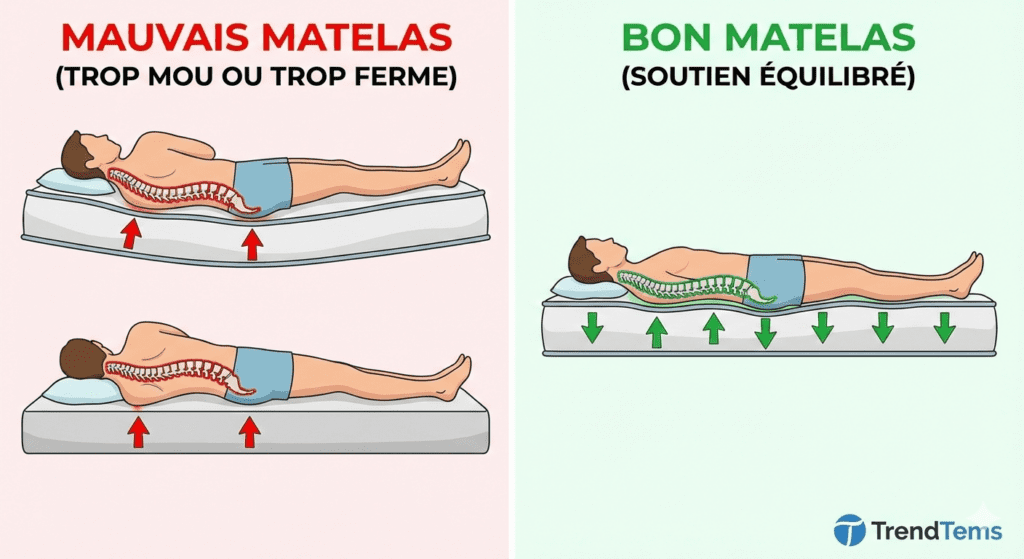
The ultimate goal of a good mattress is to maintain your spine’s natural curve, which is known as the “spinal neutrality”. Imagine your spine as a delicate string of pearls.
- If the mattress is too soft: Your hips, which are the heaviest part of your body, sink in excessively. The spine curves downward, putting strain on the ligaments and compressing one side of the discs. This is the “hammock” effect.
- If the mattress is too stiff: Your shoulders and hips don’t sink in at all. The spine is forced to curve upward to compensate. Pressure points become painful, cutting off blood flow and causing you to wake up briefly.
2. Support vs. Firmness: The Nuance That Makes All the Difference
This is where most buyers make a mistake.
- Firmness is the immediate sensation you feel when you lie down (the initial feel). It’s the “comfort” on the surface.
- Support is the ability of the mattress core (whether made of springs, latex, or foam) to withstand pressure and support your weight in order to maintain proper spinal alignment.
A mattress can be spongy on the surface (to soothe the skin and muscles) while also being very firm deep down (to support the bones and vertebrae). It is precisely this combination that people with sensitive backs are looking for.
3. Comfort Zones: The Secret of the 7 Zones
Why do we talk about “zones”? Because your body isn’t a uniform rectangle. Your shoulders are broad and light, your hips are dense and heavy, and your lower back needs to be “supported.” High-end mattresses now offer 7 zones with varying levels of support :
- Head
- Shoulders (more flexible)
- Lower back (reinforced)
- The pelvis (solid)
- Thighs
- Legs
- Feet For those with back pain, zone 3 (the lumbar region) is the most critical: it must provide extra support to prevent the lower back from arching.
II. Scientific Evidence: What Medicine Teaches Us
At TrendTems, we don't buy into the empty promises of salespeople. We rely on data.
1. The Lancet study: The verdict is in
For decades, doctors recommended sleeping on a hard surface, almost like a board. In 2003, a groundbreaking study published in the medical journal The Lancet by Dr. Francisco Kovacs has debunked this myth. By testing more than 300 people with chronic lower back pain, the study showed that patients using a mattress medium firmness (on a scale of 5–6 out of 10) were twice as likely to see an improvement in their condition compared to those on firm mattresses. Why? Because a mattress that is too hard does not allow the hips to sink in, which forces the lower back to remain tense throughout the night.
2. Harvard Medical School’s Opinion
The experts at Harvard also emphasize the importance of “surface response.” A mattress for sensitive backs must be able to distribute body weight over the largest possible surface area. If weight is concentrated on the heels, buttocks, and shoulder blades, the lower back is left unsupported.
III. Mattresses and Technology: Which Material Is Best for Your Back?
There is no single “miracle material,” but each technology offers specific benefits for sensitive skin.
1. Memory foam (viscoelastic)
Inspired by NASA research, this foam reacts to your body heat to conform exactly to your body’s contours.
- Benefits: Completely eliminates pressure points. Ideal for those who don't move much and are looking for a cozy, cocoon-like feeling.
- The key point: Density. For effective lumbar support, the foam must have a density of At least 50 kg/m³. Below that, the foam is too airy and sags after just two years, causing your pain to return.
2. Encapsulated springs
Each spring is individually wrapped in a fabric pouch. They move independently.
- Benefits: Excellent “sleep independence” (you won't feel your partner move). The support is responsive and the ventilation is perfect (ideal if you tend to get hot at night).
- For your back: This technology offers the most advanced and sustainable support.
3. Latex (Natural or Synthetic)
Latex is an elastic and resilient material (it springs back into shape instantly).
- Benefits: Unlike memory foam, you don’t feel like you’re “sinking in.” Latex actively supports the body, which makes it easier to move around at night (essential for preventing stiffness).
- Recommended density: Between 70 and 85 kg/m³.
IV. Tests & Testimonials: Putting Theory into Practice
The Hand Test (The DIY Test)
If you're buying a mattress online or testing one in a store: lie on your back. Try to slide your hand between your lower back and the mattress.
- If the hand goes through too easily: The mattress is too firm. The gap under your back forces your muscles to stay tense in order to “support” your spine.
- If you are unable to step down : The mattress is too soft. You're already sinking into it.
- Ideally : You can feel the mattress conforming to your natural curve, but you can slide your hand across it with a slight resistance.
Testimonial: Julie’s Story—A 42-Year-Old Woman Living with Chronic Sciatica
« For years, I followed my grandmother’s advice: ‘Get a firm mattress for your back.’ The result? I’d wake up with pins and needles in my hands and a stiff lower back. When I switched to a hybrid mattress (coils + latex), I realized that my back needed support, not a hard surface. Now, I no longer feel that old-age ache the moment I step out of bed. »
V. TrendTems Selection: Our Product Recommendations
1. The Orthopedic Mattress: An Investment in Your Health
A real orthopedic mattress is certified for its ability to relieve spinal conditions (herniated discs, scoliosis).
- Our recommendation : Choose models that are at least 25 cm thick. The successive layers of foam with varying densities create an essential “gradation of comfort.”
2. The Mattress Topper: The Perfect Solution
Is your mattress too hard, but you can't afford to replace it?
- The role of a mattress topper : It helps “fill in” the gaps in comfort. For those with sensitive backs, a 7-cm memory foam mattress topper provides the necessary give to allow the hips to sink in, thereby restoring lumbar alignment.
FAQ: Expert Answers to Your Questions
Should you choose a firm mattress or a medium-firm one?
As seen in the study of the Lancet, the “loose” (or balanced) is the standard. Very firm mattresses are recommended only for people weighing over 100 kg. For people of average build, a mattress that is too firm prevents muscle relaxation.
Which pillow goes best with my mattress?
If you are using a Bluetooth sleep mask To enjoy a restful night’s sleep, make sure your pillow isn’t so thick that it disrupts the alignment of your neck. A perfect mattress is useless if your pillow throws off your neck alignment. If you sleep on your side, your pillow should be exactly as wide as your shoulder. If you sleep on your back, it should be thinner.
When is it really time to replace your mattress?
The average lifespan is 10 years. But for a sensitive back, the warning sign is a “loss of resilience.” If you see an indentation left behind after you get out of bed, the mattress has lost its support. Your back will compensate for this loss of support all night long, which is why you feel pain.
Conclusion: Take care of your back—it’s one of a kind
Choosing a lumbar support mattress for back pain It’s not an expense—it’s an investment in your longevity. Quality sleep reduces inflammation, improves cell regeneration, and boosts your mood.
To get the most out of these benefits, remember that good equipment must be accompanied by a 10-minute bedtime routine to relax your muscles before falling asleep.
Don’t fall for aggressive sales pitches without checking the foam density and spring quality. Remember this science-backed golden rule: Firm support for the skeleton, soft cushioning for the muscles. Ready to transform your nights? If you’re still torn between two options, we recommend taking advantage of the trial periods offered by modern brands. It’s the only real way for your body to adjust and determine whether the lumbar support is right for you. Your spine will thank you every morning.