
Ultra-cool nights: passive cooling—no noise, no extra cost
The Issue: The Nightmare of Too-Hot Nights
It's a classic scenario: the heat wave As the heat settles in, the air becomes stifling, and your bedroom turns into a sauna. You push the comforter aside, desperately searching for the “cool side” of the pillow, but nothing helps. When you wake up, the feeling is miserable: fatigue, headaches, and irritability.
Why does heat keep you from sleeping?
From a biological standpoint, our bodies follow a circadian rhythm dictated by light and temperature. In order to fall asleep, our core body temperature must drop by about 1°C à 1,5°C. This drop in body temperature acts as a chemical signal to the brain to release melatonin, the sleep hormone.
When the room temperature exceeds 22°C-23°C, the body struggles to dissipate its own heat. Your heart rate increases slightly to pump blood to the skin to cool it down, which keeps your nervous system on high alert. As a result, you remain in light sleep, and your deep sleep phase—the one that truly restores the body—is drastically reduced.
The alternative : Passive cooling
Air conditioning may seem like the easy solution, but it has three major drawbacks: it’s noisy (which can disrupt sleep), it’s expensive (leading to sky-high electricity bills), and it dries out the mucous membranes in the respiratory tract. The passive cooling, on the other hand, is based on physics and common sense. It is the art of optimizing what already exists to Sleep comfortably without air conditioning.
I. DIY Techniques: The Art of Mastering Air and Water
Before reaching for your credit card, there are time-tested and scientifically proven ways to lower the temperature in your home.
1. Thermal management of openings
The secret to keeping your home cool lies in planning ahead. During the day, your worst enemy is sunlight.
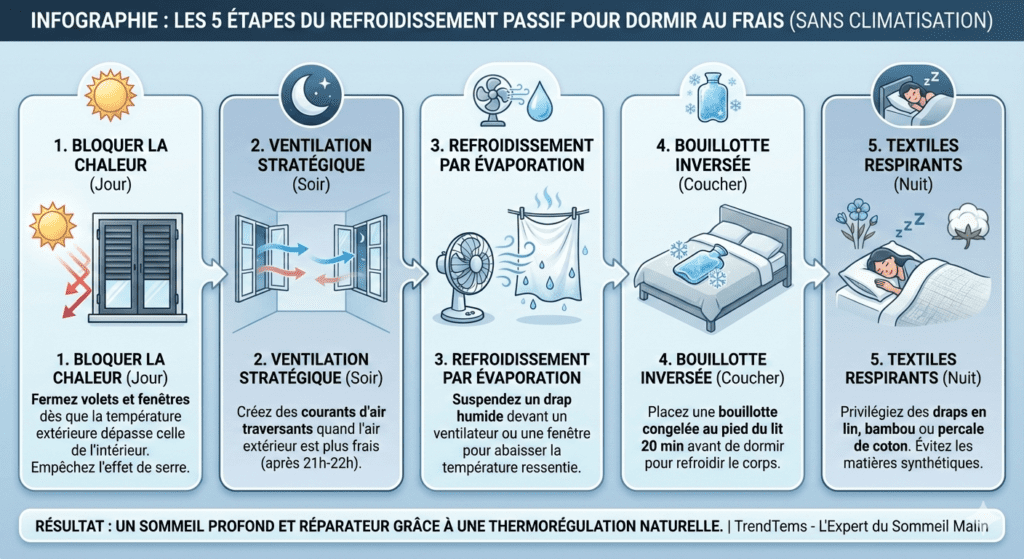
- The golden rule : Close the windows AND the shutters as soon as the outside temperature exceeds the inside temperature.
- The greenhouse effect : If you leave your windows open, they trap heat. By closing everything up, you create a thermal “cave.”
- The strategic opening : Only open windows once the outside air has cooled down (usually after 9 or 10 p.m.). Use the principle of thermal draft: open one window at the bottom and another at the top (or vice versa) to create a draft that “pushes” the warm air outside.
2. Evaporation: The traditional air conditioner
The evaporation of water consumes thermal energy. This is known as adiabatic cooling.
- The wet sheet : Hang a clean, wrung-out sheet in front of your open window or in front of a fan. The air passing through the fabric will absorb moisture and cool down by several degrees instantly.
- A warm shower : Contrary to popular belief, don’t take an ice-cold shower. Water that’s too cold causes vasoconstriction: your body closes your pores and traps heat inside to protect itself. A lukewarm shower (around 30°C) keeps your pores open, allowing heat to escape after you get out of the shower.
3. The “Reverse Hot Water Bottle”
A hot water bottle isn't just for winter.
- Fill it two-thirds full with water and put it in the freezer for the day.
- Place it at the foot of your bed 20 minutes before going to sleep. This cools your extremities, which helps lower your overall body temperature.
II. Mattresses and Textiles: The Cornerstones of Nighttime Thermoregulation
Is your bed like a radiator? If you have a low-quality memory foam mattress, the answer is probably yes. These foams tend to trap body heat.
1. Choosing the Right Mattress
If you tend to sweat at night, your next purchase should prioritize breathability.
- Pocket springs: This design provides the best airflow. Air circulates freely between the springs, unlike in compact foam blocks.
- Open-cell foams: Some modern foams (such as Airgocell or graphite/gel-infused foams) are designed to dissipate heat.
- The ultimate choice : The [Cooling Mattress Topper]. If you don’t want to replace your mattress, a temperature-regulating mattress topper is a great investment. Some models use gel microcapsules that absorb excess heat.
Note : If you suffer from lower back pain, don’t sacrifice support for comfort. Check out our guide on mattress for sensitive backs to find the perfect balance.
2. The Power of Natural Fibers
Your clothing is your first line of defense. Avoid polyester and synthetic materials: they don’t breathe and create a “plastic bag effect.”
- Flax: The undisputed king. It can absorb up to 20% of its weight in moisture without feeling wet. It feels naturally cool to the touch.
- Bamboo : It is very soft, even more absorbent than cotton, and has antibacterial properties.
- Cotton Percale: Cooler than cotton satin, its tight yet breathable weave provides that crisp, fresh “hotel-quality” feel.
- Our recommendation: Invest in [breathable linen or percale sheets] to take your comfort to the next level.
3. The Quiet Fan: An Indispensable Companion
A fan doesn't cool the air; it moves the air molecules. This helps the moisture on your skin evaporate, creating a cooling sensation (effect wind chill).
The goal is to help your metabolism reach the ideal temperature for sleeping between 16°C and 19°C
- The Key Factor : Noise. To get a good night's sleep, you need a model that produces less than 40 dB.
- The placement : Point it toward the open window to “draw in” fresh air from outside, or toward you in slow oscillation mode.
- Recommandation : Un [Ventilateur colonne silencieux] est idéal car il prend peu de place et diffuse l’air sur toute la hauteur de votre corps.
III. FAQ: Questions to Help You Optimize Your Environment
What is the exact ideal temperature for sleeping? Most sleep experts agree on a range between 16°C et 19°C. Below that temperature, the body expends energy to keep warm. Above 21°C, sleep becomes restless.
Why is moisture the enemy of a good night's sleep? This is the principle of relative humidity. If the air is already saturated with water, your sweat can no longer evaporate. Yet it is the evaporation of sweat that cools your body. At the same temperature, dry air at 25°C is much more bearable than humid air at 25°C. A dehumidifier can sometimes be more effective than a fan in tropical or humid regions.
Can you use a cooling pillow? Yes! The head is one of the areas that releases the most heat. A pillow with a cooling side or buckwheat hull filling (which allows air to circulate) can make a noticeable difference for people who experience hot flashes.
Conclusion: An investment in your health
Sleeping in a cool room isn’t a luxury—it’s essential for allowing your brain to recharge. By combining the passive cooling techniques (shutter management, hydration) and appropriate equipment such as a silent fan or some breathable sheets, you can enjoy peaceful nights without harming the planet or breaking the bank.
A note from TrendTems : Don't let the heat dictate how you feel the next day. Start with small changes (like natural fabrics) and move on to more technical solutions, such as mattress toppers, if you're still having trouble sleeping.
What’s your secret tip for beating the heat?